


Symbolic play is one of the most natural forms of learning during childhood. When a child pretends to cook, take care of a baby, be a doctor, set up a store, or teach their dolls, they are not just playing: they are representing the world around them, organizing ideas, and using language to make sense of what is happening.
Through these imagined situations, young learners expand their vocabulary, build sentences, explain actions, negotiate with others, and express emotions. Play becomes a space where language appears in a spontaneous, functional, and meaningful way.
Why Does Symbolic Play Support Language?
In symbolic play, words are not learned in isolation. They appear within a meaningful context: a doctor’s office, a store, a kitchen, a family, a school, or a veterinary clinic. This allows students to connect vocabulary with actions, objects, roles, and specific situations.
For example, when playing doctor, children do not only name body parts or tools such as a thermometer. They also use expressions like “What hurts?”, “Let’s help you feel better,” or “You need to rest.” Language is used to act, ask questions, respond, and solve a situation.
This type of play also helps children build short narratives. Young learners organize actions, create characters, explain what happened, and anticipate what will happen next. All of this supports oral comprehension, verbal expression, and, later on, skills related to reading and writing.
Representing the World to Understand It Better
When students pretend to be someone else, they imitate what they observe in their environment: gestures, words, social rules, and ways of interacting. This helps them better understand how different everyday situations work.
By acting out family, school, or social scenes, they learn what is said in each context, how to start a conversation, how to ask for help, or how to respond to another person. Language stops being a repetition of words and becomes a tool for participating in the world.
This type of play also encourages empathy, because it allows children to put themselves in the place of different characters. Being a doctor, patient, teacher, student, cook, or customer helps them understand different points of view and adapt the way they speak according to the role they are playing.
Speaking, Listening, and Reaching Agreements
When symbolic play takes place in a group, language has a very important social function. Participants have to decide what to play, assign roles, explain their ideas, solve misunderstandings, and keep the conversation going so the scene can continue.
In these situations, students practice essential language skills: listening to others, taking turns, asking questions, responding coherently, using social expressions, and adapting vocabulary to the character or context.
That is why the classroom is an especially rich environment for these types of activities. Language is not treated as a separate task, but as part of a shared, active experience that is close to students’ everyday reality.
The Role of the Adult
To support language through symbolic play, adults do not need to direct every step. Their role can be to observe, accompany, and enrich the situation through small interventions.
They can introduce new words, rephrase sentences, ask open-ended questions, or encourage students to explain what they are doing: “What does the patient need?”, “What ingredients are you going to use?”, “How can you help that animal?” or “What would you say to the customer?”
These interventions expand language without interrupting the flow of the game. They also make it possible to adapt the activity to different levels, offering support to those who need it and new challenges to those who already express themselves more confidently.
Smile and Learn as a Resource to Enrich Play
Smile and Learn offers a digital educational environment designed to support learning in Early Childhood and Elementary School through videos, interactive games, stories, songs, and classroom activities. Its resources can be used as a starting point to prepare symbolic play situations related to everyday life, social roles, and language development.
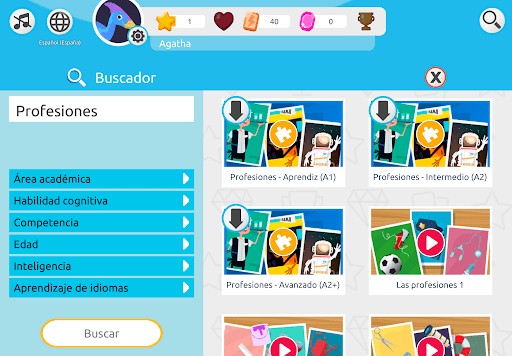
For example, content about professions helps introduce vocabulary and familiar scenes before playing. Through videos and activities, students can discover what different professionals do, what tools they use, where they work, and how they communicate. Later, this information can be transferred to play: a doctor’s office, a store, a kitchen, a school, or a veterinary clinic. In this way, children do not only learn words such as “doctor,” “teacher,” “cook,” or “veterinarian”; they use them within short communicative situations.
Smile and Learn also includes content related to family, emotions, food, animals, the human body, routines, and coexistence. All of these can become symbolic play scenarios where students practice language naturally.
When used well, technology does not replace free play, imagination, or conversation. In this case, Smile and Learn helps prepare the context, reinforce vocabulary, and offer language models that can later be transferred to the classroom or home.
Learning Language in Meaningful Situations
Symbolic play is not just a playful activity. It is a way of thinking, communicating, and understanding the world. Through it, children develop vocabulary, build sentences, tell stories, express emotions, and learn to relate to others.
When supported by educational resources such as Smile and Learn, the possibilities expand. Digital content helps introduce key words, activate prior knowledge, and create a shared context so students can play, speak, and imagine with more language tools.
That is why pretending to be doctors, cooks, store clerks, teachers, or veterinarians can become a valuable opportunity to develop language. Children do not just memorize vocabulary: they use it to act, talk, solve situations, and give meaning to what they imagine.